
Basic Handbook of Police Supervision: A Practical Guide for Law Enforcement Supervisors
Master This Core Supervision and First-Line Leadership Textbook to Build Toward Your Promotion!

By Lt. Paul Patti (ret) - Director
Police
Career and Promotion Services, LLC.
 What you need to know
about the textbooks you need to study can be found in these pages
- including real promotion test questions from each
title!
What you need to know
about the textbooks you need to study can be found in these pages
- including real promotion test questions from each
title!
Basic Handbook of Police Supervision is a core supervision textbook, creating a solid foundation for your future testing and promotion. This textbook is a practical, no-frills resource for veteran, novice, and future law enforcement supervisors. The 50+ new and classic police promotion textbooks featured on these pages form the professional basis for not only written exams, but also oral board interview questions and assessment center exercises.
Are you interested in moving up the ranks in law enforcement, maybe all the way to Chief or Sheriff? If you are, start today learning concepts and practical information that will be useful in all your written exams, oral boards and assessment center exercises. Amazon link.
About us: I spent 27 years in law enforcement, and since 1985 I have directed an organization that has worked with individuals and agencies in finding and promoting the right people into the higher ranks of police and sheriff's departments. We include a Ph.D. in Personnel Management, as well as a staff attorney focusing on criminal law applications in law enforcement.
We specialize not only in writing promotion textbook exams for police agencies, but also written exam preparation for individuals, along with in-basket, oral board and assessment center preparation for both agencies and individual training. Our individual client base has a 99%+ pass rate on their written exams!
More information about me, my organization and affiliates can be found at these links; PoliceCareer.com, About Us, PoliceCareer.net, PolicePromotion.com, Finests.com, In-Basket.net and PoliceAssessmentCenter.com.
Questions? Contact me -
Paul@PolicePromotion.com
Basic Handbook of Police Supervision is a Core Supervision and First-Line Leadership textbook used to create promotion exams. Click the links for the full evaluation and topic areas for each textbook in this grouping:
Supervision of Police Personnel
Effective Police Supervision
Supervising Police Personnel:
Strengths-Based Leadership
Management and Supervision in Law
Enforcement
Management and Supervision of Law
Enforcement Personnel
Basic Handbook of Police Supervision
Common Sense Police Supervision
Making Sergeant: The Biggest Leap in Law
Enforcement
Police Supervision and Management: In an Era
of Community Policing
On This Page — Basic Handbook of Police Supervision
Authors:
Gerald W. Garner
Publisher: Charles C. Thomas —
Current Edition:
2nd
By Lt. Paul Patti (ret.), Director,
Police Career and Promotion Services, LLC — 40+ years of law
enforcement promotion expertise.
Textbook Overview
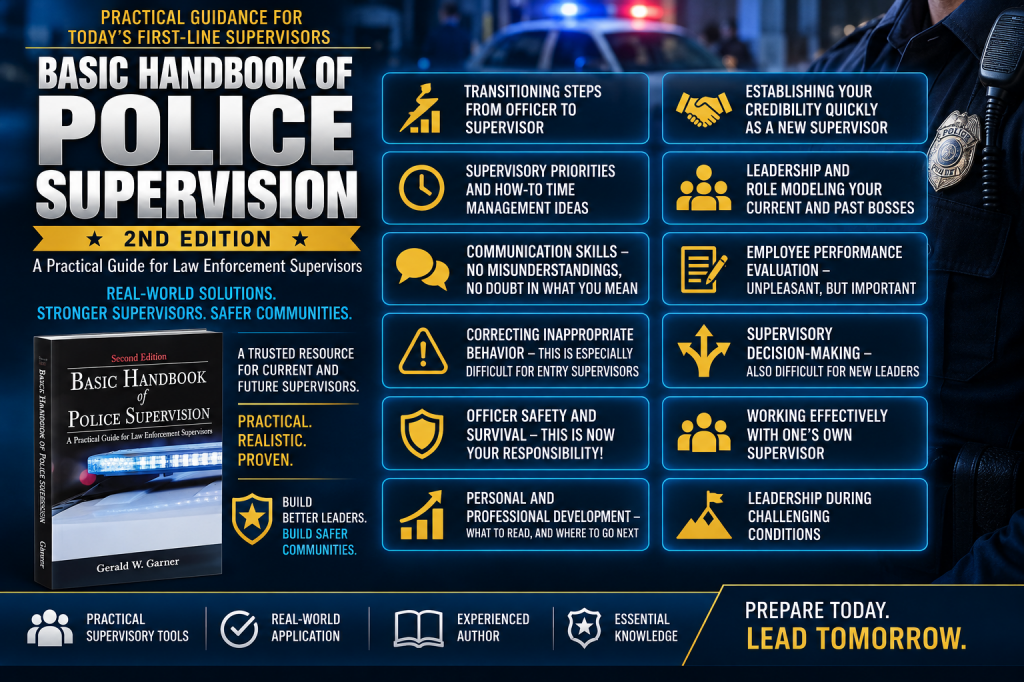
Basic Handbook of Police Supervision is deliberately different from a comprehensive academic supervision textbook. Gerald W. Garner designed it as a compact, practical guide to the everyday realities of becoming and serving as a first-line law enforcement supervisor. Its emphasis is less on extensive management theory and more on what a Sergeant or other frontline leader actually needs to recognize, decide, communicate, and accomplish on the job.
Why we love this title - and why we recommend it for testing: It fits the bill for medium and large agencies that require testing for Field Training Officer or Corporal or entry-level Detective / Investigator ranks.
Don't wait for the exam date! This is a practical textbook that is easy to read and digest for new officers and deputies who want to start studying for their first leadership position. You will be able to apply these supervisory principles to future written exams AND assessment center exercises. Amazon Link + Promotion exam questions.
That practical orientation is rooted in Chief Garner's lengthy law enforcement career. The textbook as drawing upon lessons from his 43 years in law enforcement and identifies subjects including the transition to supervision, supervisory tasks and priorities, role modeling, leadership, and communication.
The second edition strengthens the book's contemporary focus, including guidance for leading during the unusually challenging environment facing modern law enforcement. The book addresses communication, performance evaluation, correcting inappropriate behavior, officer survival, relationships with higher-ranking managers, and the supervisor's own career development. Its defining characteristic is practicality.
We use and recommend this textbook mainly because it is intended to help an officer understand what being the boss actually requires once the promotion ceremony is over and the daily responsibilities begin.
Major Subject Areas
Major Subject Areas include:
- Transitioning steps from officer to supervisor
- Establishing your credibility quickly as a new supervisor
- Supervisory priorities and how-to time management ideas
- Leadership and role modeling your current and past bosses
- Communication skills - no misunderstandings, no doubt in what you mean
- Employee performance evaluation - unpleasant, but important
- Correcting inappropriate behavior - this is especially difficult for entry supervisors
- Supervisory decision-making - also difficult for new leaders
- Officer safety and survival - this is now YOUR responsibility!
- Working effectively with one's own supervisor
- Personal and professional development - what to read, and where to go next
- Leadership during challenging conditions.
The publisher specifically emphasizes preventing routine supervisory problems from developing into crises and preserving the supervisor's emotional, physical, and moral well-being while leading others.
This gives the book an unusually grounded perspective. It recognizes that first-line supervision is simultaneously about leading employees, solving problems, protecting organizational standards, and managing oneself.
Why This Book Matters
Many newly promoted Sergeants discover that technical competence as an officer does not automatically translate into competence as a supervisor. The relationships change, expectations change, and problems that previously belonged to someone else suddenly become theirs.
This book matters because it concentrates directly on that transition.
Its concise, experience-oriented approach makes it especially useful for officers who want practical guidance without first working through a lengthy academic treatment of management theory. It addresses the everyday situations through which supervisors can quickly establish—or lose—their credibility.
For promotional preparation, that practical orientation also has value beyond factual recall. Subjects such as prioritization, communication, employee correction, leadership, and problem resolution are directly relevant to the judgment expected of candidates in written situational questions and assessment-center exercises.
Historical Promotional Influence
We at Police Career and Promotion Services, LLC are very much aware that Basic Handbook of Police Supervision does not have the multi-decade, multi-edition promotional history of titles such as Supervision of Police Personnel or Effective Police Supervision.
This means it should not be characterized as one of the historical giants of promotional literature. However, its significance lies elsewhere. The original work was recognized by the Department of Justice's NCJRS collection as a practical guide to police supervision, and a second edition was published in 2022. That makes it better classified as a modern practical supervision resource rather than a historical promotional classic.
Its greatest potential value in promotional testing is likely where an agency wants candidates exposed to realistic first-line leadership principles without assigning a substantially larger academic text.
Current Professional Relevance
The 2022 edition gives this title an important advantage over older practical supervision books: Garner has revisited the material in the context of the increasingly difficult modern environment confronting law enforcement supervisors.
The updated edition specifically addresses the challenge of preventing supervisory situations from escalating into crises. It does this by emphasizing and focusing on leadership, communication, performance, behavior correction, employee survival, and the supervisor's own emotional, physical, and moral health.
Those are highly contemporary concerns. We like the focus of this textbook, as we've already stated, for small to medium-sized agencies. Does your agency sometimes have a two-stripe FTO or Corporal sometimes supervising all personnel on duty? If so, this is a textbook worth considering for your next promotional exam.
The book is current not because it attempts to cover every emerging policing issue, but because the central problems it addresses—people, judgment, communication, credibility, performance and leadership under pressure—remain fundamental to the new first-line supervisor.
If This is the Only Leadership Book You Read ...
If Basic Handbook of Police Supervision is the only supervision book you read, you will not receive the breadth of organizational theory contained in some of the profession's larger textbooks.
You will receive something different: a concentrated introduction to what it feels like and what it takes to actually supervise police officers.
You should come away with a stronger appreciation for the transition from coworker to supervisor; the importance of communication and leading by example; the need to prioritize competing responsibilities; and the reality that effective supervisors must manage themselves as carefully as they manage others.
For the aspiring or newly promoted Corporal, Detective, FTO or Sergeant who wants practical guidance that can be translated quickly into daily supervisory behavior, that is a substantial strength.
Promotion Exam Questions Available for Basic Handbook of Police Supervision
Click here for exam questions from these editions of the textbook, including a proven study method and bonus items. You can also sign up to try our system - no name or credit card needed:- Basic Handbook of Police Supervision Garner 2E - 240+ questions
- Basic Handbook of Police Supervision Garner 1E - 200+ questions
Do You REALLY Want the Promotion? — Textbooks to help you prepare for:
 Police Corporal
Police Detective
Police Sergeant
Police Lieutenant
Police Captain
Police
Administration and Upper Management
Understanding Police Leadership Concepts
Understanding Police Ethical Considerations
Understanding Police
Patrol and Field Operations
Understanding Community
and Problem-Oriented Policing
Understanding Intelligence-Led Policing
Police Case Law
Application with Case Law Pro
Police Corporal
Police Detective
Police Sergeant
Police Lieutenant
Police Captain
Police
Administration and Upper Management
Understanding Police Leadership Concepts
Understanding Police Ethical Considerations
Understanding Police
Patrol and Field Operations
Understanding Community
and Problem-Oriented Policing
Understanding Intelligence-Led Policing
Police Case Law
Application with Case Law ProMaster list of articles and resources: from PolicePromotion.net
Your Police Promotion Timeline — When Should
Preparation Begin?
Field Training — Your First Defining Chapter
Building Your Promotional Reputation Over Time
How Citizen Complaints Can Affect Your Promotion Chances
Recordkeeping —
Your Evaluations, and Training Documentation
Great Police Leaders Focus on the Details — Here's How!
The Two Tracks —
Supervision vs. Specialization
The Role of College Education
in Law Enforcement
The FTO As an Early Promotion Credential
The Written Promotional
Exam — What It Covers and How to Prepare
The Oral Board — the
Promotion First-Timer's Biggest Challenge
The In-Basket Exercise
— NOT as
Easy as You Think!
Assessment Center Exercises
—
Don't Fear — Prepare!
Making it To The Top — Or — How High is
High Enough?
When it's Time to Leave it All Behind — And What to
do Next.