
Management and Supervision in Law Enforcement
Master This Core Supervision and First-Line Leadership Textbook to Build Toward Your Promotion!

By Lt. Paul Patti (ret) - Director
Police
Career and Promotion Services, LLC.
 What you need to know
about the textbooks you need to study can be found in these pages
- including real promotion test questions from each
title!
What you need to know
about the textbooks you need to study can be found in these pages
- including real promotion test questions from each
title!
Management and Supervision in Law Enforcement is a core leadership and supervision textbook, creating a solid foundation for your future testing and promotion. The 50+ new and classic police promotion textbooks featured on these pages form the professional basis for not only written exams, but also oral board interview questions and assessment center exercises.
Are you interested in moving up the ranks in law enforcement, maybe all the way to Chief or Sheriff? If you are, start today learning concepts and practical information that will be useful in all your written exams, oral boards and assessment center exercises. Amazon Link.
About us: I spent 27 years in law enforcement, and since 1985 I have directed an organization that has worked with individuals and agencies in finding and promoting the right people into the higher ranks of police and sheriff's departments. We include a Ph.D. in Personnel Management, as well as a staff attorney focusing on criminal law applications in law enforcement.
We specialize not only in writing promotion textbook exams for police agencies, but also written exam preparation for individuals, along with in-basket, oral board and assessment center preparation for both agencies and individual training. Our individual client base has a 99%+ pass rate on their written exams!
More information about me, my organization and affiliates can be found at these links; PoliceCareer.com, About Us, PoliceCareer.net, PolicePromotion.com, Finests.com, In-Basket.net and PoliceAssessmentCenter.com.
Questions? Contact me -
Paul@PolicePromotion.com
Management and Supervision in Law Enforcement is a Core Supervision and First-Line Leadership textbook used to create promotion exams. Click the links for the full evaluation and topic areas for each textbook in this grouping:
Supervision of Police Personnel
Effective Police Supervision
Supervising Police Personnel:
Strengths-Based Leadership
Management and Supervision in Law
Enforcement
Management and Supervision of Law
Enforcement Personnel
Basic Handbook of Police Supervision
Common Sense Police Supervision
Making Sergeant: The Biggest Leap in Law
Enforcement
Police Supervision and Management: In an Era
of Community Policing
On This Page — Management and Supervision in Law Enforcement
Authors:
Hess and Orthmann
Publisher: Cengage —
Current Edition: 7th
By Lt. Paul Patti (ret.), Director,
Police Career and Promotion Services, LLC — 40+ years of law
enforcement promotion expertise.
Textbook Overview
Management and Supervision in Law Enforcement is one of the broader titles in the first-line leadership category because it deliberately spans the territory between supervision and management.
Rather than focusing exclusively on the newly promoted Sergeant, this textbook examines law enforcement organizations, supervisors, managers, employees, and the communities they serve.
The seventh edition places increased emphasis on leadership while incorporating contemporary policing models including
-
CompStat
-
intelligence-led policing
-
evidence-based policing
-
and predictive policing.
Why we love this textbook and write promotional exams from it: Its scope is substantial:
-
communication
-
decision-making
-
problem solving
-
time management
-
training
-
employee development
-
motivation
-
labor relations
-
grievances
-
discipline
-
stress
-
resource deployment
-
budgeting
-
productivity
-
and performance evaluation.
That breadth makes the book useful in a way that differs from the more narrowly practical supervision titles. It asks the reader to understand not only how to supervise employees, but also how supervisory decisions fit within the management of the organization.
This is a textbook you should read NOW - BEFORE a sergeant promotion exam is announced - you will be leaps and bounds ahead in your ability to transition to a supervisory role, and you will be able to apply these supervisory principles to future written exams AND assessment center exercises. Amazon Link + Promotion exam questions.
Preparation for Oral Boards and Assessment Centers is part of the draw of this textbook. Understanding and citing the specific leadership principles that define why a supervisory action is taking place, or should take place, is the essence of the oral board, in-basket assessment, role-play exercise and many other modern assessment exercises. Quoting directly from the text shows the ultimate in professional preparation for your new role as a supervisor and leader.
Major Subject Areas
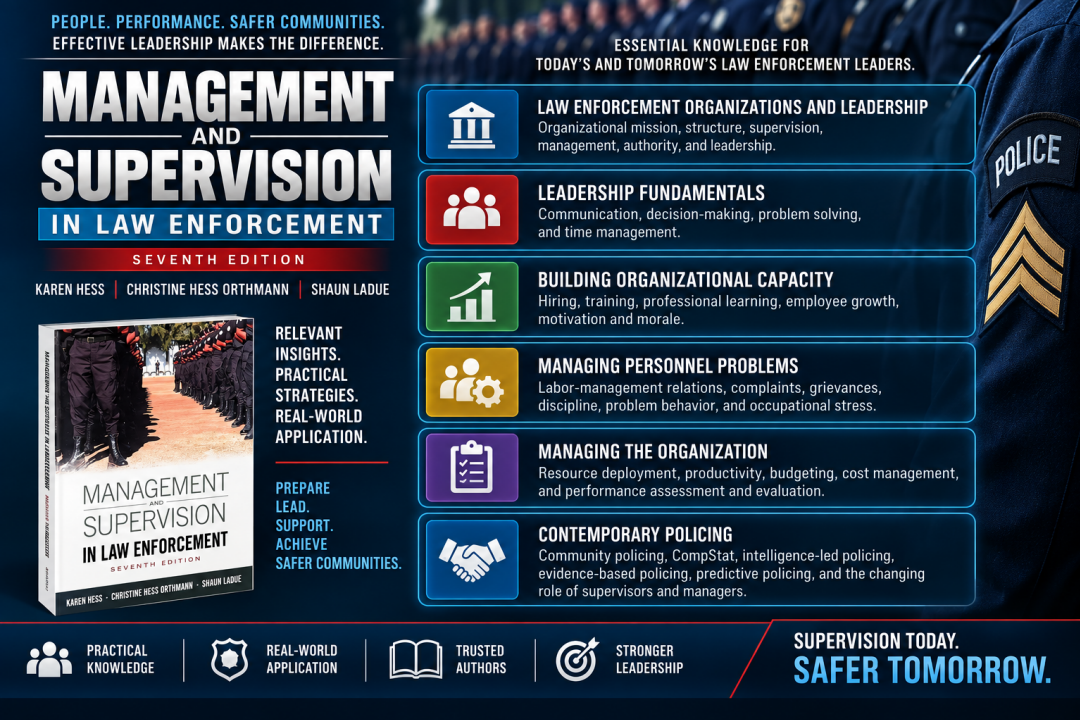
Law Enforcement Organizations and Leadership — organizational mission, structure, supervision, management, authority and leadership.
Leadership Fundamentals — communication, decision-making, problem solving, and time management.
Building Organizational Capacity — hiring, training, professional learning, employee growth, motivation and morale.
Managing Personnel Problems — labor-management relations, complaints, grievances, discipline, problem behavior, and occupational stress.
Managing the Organization — resource deployment, productivity, budgeting, cost management, performance assessment and evaluation.
Contemporary Policing — community policing, CompStat, intelligence-led policing, evidence-based policing, predictive policing, and the changing role of supervisors and managers.
The result is a textbook that moves progressively from individual leadership skills to organizational management responsibilities.
Why This Book Matters
This book matters because promotional ranks do not fit neatly into academic categories.
In many agencies, a Sergeant supervises—but also manages.
In many agencies, a Lieutenant manages—but frequently still supervises.
In smaller agencies, those distinctions become even less clear.
Management and Supervision in Law Enforcement addresses that reality particularly well because it does not artificially separate leadership, supervision, personnel development, problem solving, budgeting, resource allocation, and organizational performance.
That breadth gives agencies considerable flexibility when selecting material for promotional processes.
It also helps candidates understand an important career-development principle: promotion gradually changes the scale of responsibility. The officer begins by being responsible primarily for personal performance; the Sergeant becomes responsible for other employees; and higher-ranking managers increasingly become responsible for systems, resources, and organizational outcomes.
This textbook helps illuminate that progression.
Historical Promotional Influence
This textbook's early editions already emphasized communication, planning, budgeting, problem solving, employee development, motivation, discipline, grievances, stress, productivity, and performance evaluation.
Then this textbooks progressed to the current seventh edition, demonstrating significant longevity within law enforcement education.
More importantly, this textbook still sees extensive use in promotional exams. A recent New Jersey Civil Service Commission Police Captain orientation guide identified the seventh edition as source material used to develop police supervision and management questions.
Its longevity also shows how the book has evolved alongside changes in policing—from traditional management and supervision toward leadership, community policing, intelligence, evidence-based practices, and data-driven management.
Current Professional Relevance
The seventh edition dates to 2015/2016, so some contemporary examples—particularly technology, predictive policing, post-9/11 issues, and specific operational developments— are dated, but do reflect the period in which it was written.Nevertheless, much of its central content remains highly relevant:
Communication.
Decision-making.
Problem solving.
Employee development.
Motivation.
Labor relations.
Discipline.
Stress.
Resource deployment.
Budgeting.
Performance evaluation.
These are not temporary policing trends. They are recurring responsibilities of law enforcement supervisors and managers.
The book also deserves credit for incorporating evidence-based policing, intelligence-led policing, CompStat and other data-oriented approaches into its discussion of contemporary management.
We at Police Career and Promotion Services, LLC classify this seventh edition as an established modern-era management and supervision text that remains professionally useful but should be supplemented for developments occurring since the mid-2010s.
If This is the Only Leadership Book You Read ...
If Management and Supervision in Law Enforcement is the only book you read on supervision and management, you will receive something especially valuable: breadth.
You will learn about the interpersonal responsibilities of leadership—communication, motivation, employee development and discipline—but you will also encounter the organizational responsibilities that become increasingly important as you advance: staffing, labor relations, resource deployment, budgeting, productivity, and performance evaluation.
That makes the book particularly useful for officers who do not view Sergeant as their final promotional destination.
It helps the reader understand first-line supervision while simultaneously introducing the broader management perspective required at higher ranks.
No single text can fully prepare someone for every level of leadership. But this one provides an unusually broad view of the progression from officer to supervisor to manager, which remains one of its strongest professional-development qualities.
Promotion Exam Questions Available for Management and Supervision in Law Enforcement
Click here for exam questions from these editions of the textbook, including a proven study method and bonus items. You can also sign up to try our system - no name or credit card needed:Management and Supervision in Law Enforcement 7E - 370+ questions
Management and Supervision in Law Enforcement 6E - 230+ questions
Management and Supervision in Law Enforcement 5E - 230+ questions
Do You REALLY Want the Promotion? — Textbooks to help you prepare for:
Police Corporal
Police Detective
Police Sergeant
Police Lieutenant
Police Captain
Police Administration and Upper Management
Understanding Police Leadership Concepts
Understanding Police Ethical Considerations
Understanding Police Patrol and Field Operations
Understanding Community and Problem-Oriented Policing
Understanding Intelligence-Led Policing
Police Case Law Application with Case Law Pro
Master list of articles and resources: from PolicePromotion.net
Your Police Promotion Timeline — When Should Preparation Begin?
Field Training — Your First Defining Chapter
Building Your Promotional Reputation Over Time
How Citizen Complaints Can Affect Your Promotion Chances
Recordkeeping — Your Evaluations, and Training Documentation
Great Police Leaders Focus on the Details — Here's How!
The Two Tracks — Supervision vs. Specialization
The Role of College Education in Law Enforcement
The FTO As an Early Promotion Credential
The Written Promotional Exam — What It Covers and How to Prepare
The Oral Board — the Promotion First-Timer's Biggest Challenge
The In-Basket Exercise — NOT as Easy as You Think!
Assessment Center Exercises — Don't Fear — Prepare!
Making it To The Top — Or — How High is High Enough?
When it's Time to Leave it All Behind — And What to do Next.