
Making Sergeant: The Biggest Leap in Law Enforcement
Master This Core Supervision and First-Line Leadership Textbook to Build Toward Your Promotion!

By Lt. Paul Patti (ret) - Director
Police
Career and Promotion Services, LLC.
 What you need to know
about the textbooks you need to study can be found in these pages
- including real promotion test questions from each
title!
What you need to know
about the textbooks you need to study can be found in these pages
- including real promotion test questions from each
title!
Making Sergeant: The Biggest Leap in Law Enforcement is a new core textbook, creating a solid foundation for your future testing and promotion. The 50+ new and classic police promotion textbooks featured on these pages form the professional basis for not only written exams, but also oral board interview questions and assessment center exercises.
Are you interested in moving up the ranks in law enforcement, maybe all the way to Chief or Sheriff? If you are, start today learning concepts and practical information that will be useful in all your written exams, oral boards and assessment center exercises. Amazon link.
About us: I spent 27 years in law enforcement, and since 1985 I have directed an organization that has worked with individuals and agencies in finding and promoting the right people into the higher ranks of police and sheriff's departments. We include a Ph.D. in Personnel Management, as well as a staff attorney focusing on criminal law applications in law enforcement.
We specialize not only in writing promotion textbook exams for police agencies, but also written exam preparation for individuals, along with in-basket, oral board and assessment center preparation for both agencies and individual training. Our individual client base has a 99%+ pass rate on their written exams!
More information about me, my organization and affiliates can be found at these links; PoliceCareer.com, About Us, PoliceCareer.net, PolicePromotion.com, Finests.com, In-Basket.net and PoliceAssessmentCenter.com.
Questions? Contact me -
Paul@PolicePromotion.com
Making Sergeant: The Biggest Leap in Law Enforcement is a new Core Supervision and First-Line Leadership textbook we have used to create promotion exams. Click the links for the full evaluation and topic areas for each textbook in this grouping:
Supervision of Police Personnel
Effective Police Supervision
Supervising Police Personnel:
Strengths-Based Leadership
Management and Supervision in Law
Enforcement
Management and Supervision of Law
Enforcement Personnel
Basic Handbook of Police Supervision
Common Sense Police Supervision
Making Sergeant: The Biggest Leap in Law
Enforcement
Police Supervision and Management: In an Era
of Community Policing
On This Page — Making
Sergeant: The Biggest Leap in Law Enforcement
Authors:
Gerald W. Garner
Publisher: Charles C. Thomas —
Current Edition: 1st
By Lt. Paul Patti (ret.), Director,
Police Career and Promotion Services, LLC — 40+ years of law
enforcement promotion expertise.
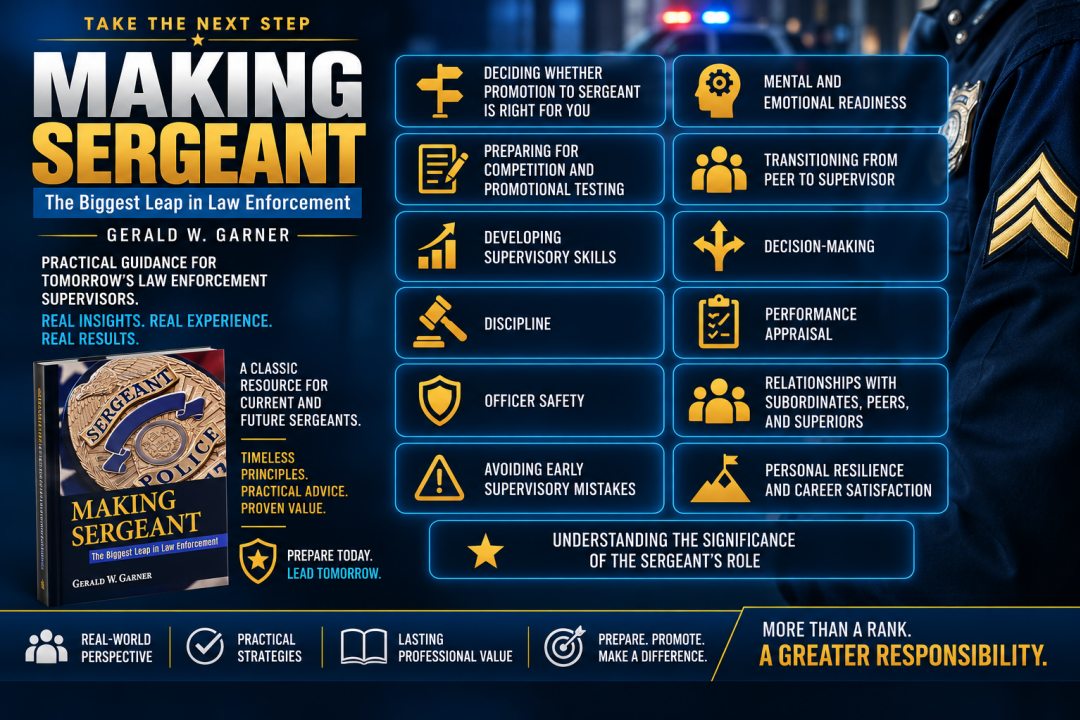
Textbook Overview
Making Sergeant: The Biggest Leap in Law Enforcement is different from most promotion textbooks because it is written specifically around the career transition into first-line supervision.
Gerald W. Garner approaches the subject from the perspective of a veteran police chief with more than 50 years in law enforcement, including 15 years as a Sergeant. The book addresses three questions in sequence:
Are you ready to become a Sergeant?
How do you compete successfully for the position?
And once promoted, how do you succeed in the role?
Why we like this textbook and choose it for sergeant promotion exams: We use this textbook because is intentionally short on theory and heavy on pragmatic advice. It discusses the emotional and professional realities of promotion, preparation and test taking, decision-making, discipline, performance appraisal, employee safety, relationships with subordinates and superiors, and adapting to the altered perspective that accompanies supervisory rank.
That makes it less of a conventional supervision textbook and more of a transition manual for aspiring and newly promoted Sergeants.
This is a textbook you should read NOW - BEFORE a promotion exam is announced - you will be leaps and bounds ahead in your ability to transition to a supervisory role, and you will be able to apply these supervisory principles to future written exams AND assessment center exercises. Amazon Link + Promotion exam questions.
Preparation for Oral
Boards and Assessment Centers is part of the
draw of this textbook. Understanding and citing the specific
leadership principles that define why a supervisory action is
taking place, or should take place, is the essence of the oral
board, in-basket assessment, role-play exercise and many other
modern assessment exercises. You quoting directly from the text
shows the ultimate in professional preparation for your new role
as a supervisor and leader.
Major Subject Areas:
- Deciding whether promotion to Sergeant is right for you
- Mental and emotional readiness
- Preparing for competition and promotional testing
- Transitioning from peer to supervisor
- Developing supervisory skills
- Decision-making
- Discipline
- Performance appraisal
- Officer safety
- Relationships with subordinates, peers, and superiors
- Avoiding early supervisory mistakes
- Personal resilience and career satisfaction
- Understanding the significance of the Sergeant’s role
The book’s structure moves intentionally from wanting the job, to winning the job, to performing the job successfully.
Why This Book Matters
This book matters because the transition to Sergeant is often treated too casually.
An officer may prepare intensely to win a promotional examination without spending enough time deciding whether he or she is truly ready for the responsibilities that follow.
We like the fact that Chief Garner confronts that issue directly.
The book recognizes that becoming a Sergeant changes relationships, expectations, accountability, and identity within the organization. A successful candidate is no longer simply one of the team; the new supervisor must evaluate employees, make unpopular decisions, impose discipline when necessary, protect personnel, and represent management.
That makes Making Sergeant particularly valuable as a preparation and orientation resource.
It may also be useful in assessment-center preparation because many of the issues it emphasizes—decision-making, discipline, performance, relationships, judgment, and understanding the supervisor’s role—are exactly the competencies candidates are expected to demonstrate rather than merely describe.
Historical Promotional Influence
Because the book was published in 2021, it does not yet possess the long historical promotional influence of Effective Police Supervision, Supervision of Police Personnel, or Common Sense Police Supervision.
Unlike those older texts, however, Making Sergeant was conceived around promotion itself. Its table of contents includes preparation and test-taking, the skills required after promotion, discipline, performance appraisal, decision-making, and surviving successfully in the new supervisory role.
That gives it a clear
place within the promotional-development literature even though
insufficient time has passed to call it a historical classic.
Current Professional Relevance
This textbook was explicitly framed against contemporary concerns about police performance and reform. More importantly, its central subject is timeless: the difficulty of moving from line officer to first-line supervisor.
Current staffing shortages and comparatively younger supervisory ranks in some agencies may actually increase the book’s relevance. Agencies sometimes must promote officers with less accumulated experience than previous generations possessed, increasing the importance of intentional preparation for supervisory responsibilities.
Because the book is focused more on the transition and human realities of promotion than on rapidly changing law or technology, its core guidance should retain usefulness for some time.
If This is the Only Leadership Book You Read ...
If Making Sergeant is the only book you read before seeking promotion, you will probably understand the transition better than you understand the complete academic field of police supervision.
And that is precisely the book’s strength.
It forces the reader to ask whether promotion is truly desired, whether the responsibilities are understood, whether the work required to compete is acceptable, and whether the candidate is prepared to change relationships and behavior after promotion.
You will gain practical guidance on decision-making, discipline, performance appraisal, employee safety, and succeeding in the new role—but the book’s greatest contribution is helping you recognize that becoming a Sergeant is not simply receiving stripes and enjoying a pay raise. It is a fundamental change in professional responsibility. For the newly promoted Sergeant who wants practical guidance that can be translated quickly into daily supervisory behavior, that is a substantial strength.
For aspiring Sergeants, that is a lesson worth learning before the promotional process rather than afterward.
Promotion Exam Questions Available for Making Sergeant: The Biggest Leap in Law Enforcement
Click here for exam questions from these editions of this textbook, including a proven study method and bonus items. You can also sign up to try our system - no name or credit card needed:Making Sergeant: The Biggest Leap in Law Enforcement - Gerald Garner 1E - 170+ questions
Do You REALLY Want the Promotion? — Textbooks to help you prepare for:
 Police Corporal
Police Detective
Police Sergeant
Police Lieutenant
Police Captain
Police
Administration and Upper Management
Understanding Police Leadership Concepts
Understanding Police Ethical Considerations
Understanding Police
Patrol and Field Operations
Understanding Community
and Problem-Oriented Policing
Understanding Intelligence-Led Policing
Police Case Law
Application with Case Law Pro
Police Corporal
Police Detective
Police Sergeant
Police Lieutenant
Police Captain
Police
Administration and Upper Management
Understanding Police Leadership Concepts
Understanding Police Ethical Considerations
Understanding Police
Patrol and Field Operations
Understanding Community
and Problem-Oriented Policing
Understanding Intelligence-Led Policing
Police Case Law
Application with Case Law ProMaster list of articles and resources: from PolicePromotion.net
Your Police Promotion Timeline — When Should
Preparation Begin?
Field Training — Your First Defining Chapter
Building Your Promotional Reputation Over Time
How Citizen Complaints Can Affect Your Promotion Chances
Recordkeeping —
Your Evaluations, and Training Documentation
Great Police Leaders Focus on the Details — Here's How!
The Two Tracks —
Supervision vs. Specialization
The Role of College Education
in Law Enforcement
The FTO As an Early Promotion Credential
The Written Promotional
Exam — What It Covers and How to Prepare
The Oral Board — the
Promotion First-Timer's Biggest Challenge
The In-Basket Exercise
— NOT as
Easy as You Think!
Assessment Center Exercises
—
Don't Fear — Prepare!
Making it To The Top — Or — How High is
High Enough?
When it's Time to Leave it All Behind — And What to
do Next.