
Supervision of Police Personnel
Master This Core Supervision and First-Line Leadership Textbook to Build Toward Your Promotion!

By Lt. Paul Patti (ret) - Director
Police
Career and Promotion Services, LLC.
 What you need to know
about the textbooks you need to study can be found in these pages
- including real promotion test questions from each
title!
What you need to know
about the textbooks you need to study can be found in these pages
- including real promotion test questions from each
title!
Supervision of Police Personnel is a core textbook, creating a solid foundation for your future testing and promotion. The 50+ new and classic police promotion textbooks featured on these pages form the professional basis for not only written exams, but also oral board interview questions and assessment center exercises.
Are you interested in moving up the ranks in law enforcement, maybe all the way to Chief or Sheriff? If you are, start today learning concepts and practical information that will be useful in all your written exams, oral boards and assessment center exercises. Amazon Link.
About us: I spent 27 years in law enforcement, and since 1985 I have directed an organization that has worked with individuals and agencies in finding and promoting the right people into the higher ranks of police and sheriff's departments. We include a Ph.D. in Personnel Management, as well as a staff attorney focusing on criminal law applications in law enforcement.
We specialize not only in writing promotion textbook exams for police agencies, but also written exam preparation for individuals, along with in-basket, oral board and assessment center preparation for both agencies and individual training. Our individual client base has a 99%+ pass rate on their written exams!
More information about me, my organization and affiliates can be found at these links; PoliceCareer.com, About Us, PoliceCareer.net, PolicePromotion.com, Finests.com, In-Basket.net and PoliceAssessmentCenter.com.
Questions? Contact me -
Paul@PolicePromotion.com
Supervision of Police Personnel is a Core Supervision and First-Line Leadership textbook used to create promotion exams. Click the links for the full evaluation and topic areas for each textbook in this grouping:
Detailed Analysis and Promotion Exams for All Core Supervision and First-Line Leadership Titles:
Supervision of Police Personnel
Effective Police Supervision
Supervising Police Personnel:
Strengths-Based Leadership
Management and Supervision in Law
Enforcement
Management and Supervision of Law
Enforcement Personnel
Basic Handbook of Police Supervision
Common Sense Police Supervision
Making Sergeant: The Biggest Leap in Law
Enforcement
Police Supervision and Management: In an Era
of Community Policing
On This Page — Supervision of
Police Personnel
Authors:
Nathan F. Iannone, Marvin D. Iannone, Jeff Bernstein, Robert Dowd
Publisher: Pearson —
Current Edition: 10th.
By Lt. Paul Patti (ret.), Director,
Police Career and Promotion Services, LLC — 40+ years of law
enforcement promotion expertise.
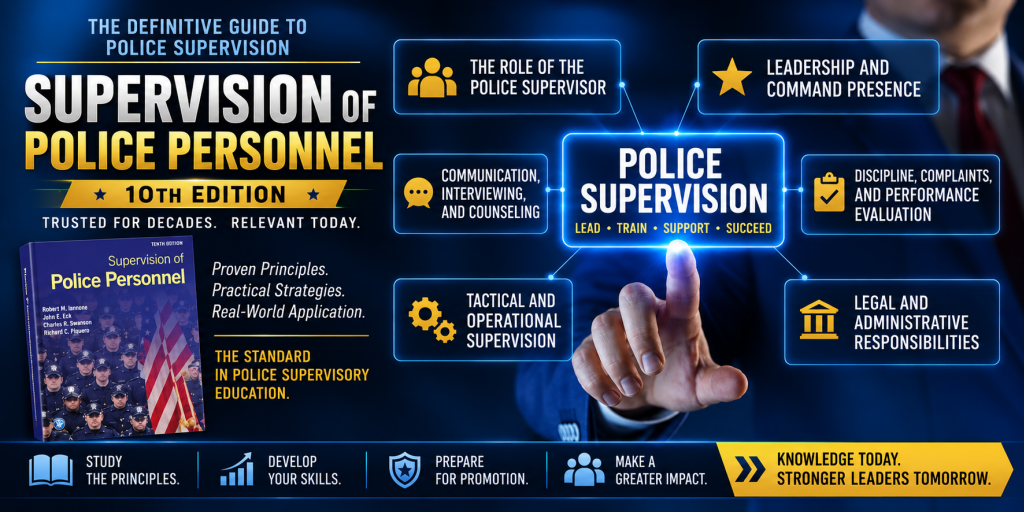
Textbook Overview
For many years, Supervision of Police Personnel has been regarded by law enforcement educators and promotional candidates as one of the foundational textbooks on police supervision.
Our experience writing exams goes back to 1985, when we first wrote promotion exam questions from the 4th and 5th edition. Right now this textbook (often abbreviated SOPP) is on its 10th edition, with an 11th edition highly likely before 2030.
SOPP is frequently described as the "bible of police supervision," the book has maintained a strong reputation through multiple editions by focusing on the knowledge, skills, and professional judgment expected of first-line law enforcement supervisors.
What 1 thing sets this
textbook apart? Unlike many general texts, it
was written specifically for
police supervision and continues to serve both
as a college-level textbook and for promotional exam
preparation.
The Tenth Edition continues this tradition
while addressing many of the complex issues facing today's
supervisors. In addition to its longstanding coverage of
leadership, communication, discipline, performance evaluation,
and supervisory responsibilities, this edition expands its
discussion of workforce diversity, fitness-for-duty evaluations,
active shooter response, accreditation, and other contemporary
management challenges. A new glossary of supervisory terminology
also reflects the publisher's effort to make the book more
useful as both a classroom resource and a professional
reference.
We believe that one characteristic that distinguishes
Supervision of Police Personnel from many other supervision
textbooks is its emphasis on
the practical responsibilities of supervising police employees.
Throughout the text, considerable attention is devoted to:
- interviewing
- counseling
- employee grievances
- disciplinary procedures
- complaint investigations
- performance evaluation
- tactical supervision.
These subjects closely mirror many of the responsibilities that newly promoted Sergeants encounter shortly after assuming their new supervisory role.
Preparation for Oral Boards and Assessment Centers is part of the draw of this textbook. Understanding and citing the specific leadership principles that define why a supervisory action is taking place, or should take place, is the essence of the oral board, in-basket assessment, role-play exercise and many other modern assessment exercises. Quoting directly from the text shows the ultimate in professional preparation for your new role as a supervisor and leader.
Apply these supervisory principles to future written exams AND assessment center exercises: Amazon Link + Promotion exam questions.
From
our experience developing promotional examinations for municipal
police departments and sheriff's offices,
Supervision of Police
Personnel has consistently been one of the most frequently
selected textbooks for Sergeant promotional examinations.
In many smaller agencies, where Lieutenants continue to
supervise personnel directly, the book has also served as an
effective foundation for Lieutenant promotional processes. Its
continued revision and publication reinforce its standing as one
of the profession's enduring references on police supervision.
Major Subject Areas
Rather than presenting supervision as a purely theoretical
management discipline, Supervision of Police Personnel examines
the practical responsibilities supervisors encounter throughout
their careers. The major subject areas work together to provide
a comprehensive understanding of first-line leadership within
law enforcement.
The Role of the Police Supervisor
The book begins by examining the supervisor's
responsibilities within the law enforcement organization and the
transition from officer to supervisor. It establishes the
expectation that supervisors must balance operational
effectiveness, leadership, organizational accountability, and
employee development.
Leadership and Command Presence
Leadership receives significant attention throughout the
text, emphasizing professional influence, supervisory
credibility, decision-making, and command presence. Rather than
viewing leadership solely as authority, the authors present it
as a combination of competence, integrity, communication, and
professional example.
Communication, Interviewing, and
Counseling
The book devotes extensive attention to
interpersonal communication, employee interviewing, counseling,
remediation, and conflict resolution. These skills are presented
as essential supervisory responsibilities that directly
influence employee performance and organizational effectiveness.
Discipline, Complaints, and Performance Evaluation
A
substantial portion of the textbook examines disciplinary
systems, complaint investigations, employee evaluations, and
supervisory accountability. These topics recognize that
supervisors play a central role in maintaining professional
standards while ensuring fairness and consistency throughout the
organization.
Tactical and Operational Supervision
Unlike many general supervision texts, the book also
explores tactical deployment, field supervision, and operational
decision-making during critical incidents. This practical
emphasis reflects the realities of supervising law enforcement
personnel in dynamic operational environments.
Legal and
Administrative Responsibilities
The Tenth Edition
continues to recognize that supervisors must understand the
legal and administrative framework within which they operate.
Supervisory decisions frequently involve legal, ethical, and
policy considerations that extend well beyond operational
policing.
Why This Book Matters
The transition from police officer to Sergeant requires more
than technical competence. Supervisors must learn to manage
people, resolve problems, maintain professional standards, and
balance organizational expectations with employee needs.
Supervision of Police Personnel was developed specifically to
address those responsibilities.
What makes this book
particularly valuable is its practical orientation. Rather than
discussing supervision solely from an academic perspective, it
focuses on situations supervisors regularly encounter throughout
their careers. Topics such as interviewing employees, handling
complaints, conducting evaluations, counseling officers,
addressing disciplinary issues, and supervising tactical
operations are presented as essential supervisory
responsibilities rather than isolated administrative functions.
For promotional candidates, or any law officer wanting to
broaden their professional knowledge, this textbook offers broad
preparation across many of the subject areas commonly emphasized
during Sergeant promotional examinations. For agencies, it
provides a balanced resource that combines leadership principles
with practical supervisory guidance. The continued publication
of new editions demonstrates the publisher's commitment to
maintaining the book's relevance as policing evolves.
Historical Promotional Influence
Few supervision textbooks have enjoyed the long-term
professional recognition of Supervision of Police Personnel. For
decades, the book has been widely adopted by criminal justice
programs, supervisory training courses, and law enforcement
agencies seeking a comprehensive text for first-line
supervision. Pearson continues to describe it as an established
resource for police administration, management, and supervision
and notes its longstanding reputation within the profession.
From our experience assisting agencies with promotional
examination development, Supervision of Police Personnel has
consistently ranked among the most frequently selected textbooks
for corporal, sergeant and lieutenant promotional processes.
Why we love this textbook and write promotional exams
from it: Its emphasis on practical
supervision, employee management, discipline, communication, and
tactical leadership has made it particularly attractive to
agencies seeking a single comprehensive supervision text.
One reason for its continued influence is that the book has
remained focused on the responsibilities of the first-line
supervisor while evolving to address changing organizational and
operational challenges. This balance between enduring
supervisory principles and contemporary policing issues has
contributed significantly to its longevity.
Current Professional Relevance
Today's police supervisors operate within an environment
characterized by heightened public accountability, evolving
legal standards, technological change, recruitment challenges,
officer wellness initiatives, and increasingly complex
operational demands. The Tenth Edition reflects many of these
developments through expanded discussions of workforce
diversity, fitness-for-duty evaluations, accreditation, active
shooter response, and contemporary management issues.
Despite these updates, the textbook continues to emphasize
supervisory principles that remain essential regardless of
changing policies or technology. Communication, leadership,
employee development, performance evaluation, ethical conduct,
and organizational accountability continue to form the
foundation of effective supervision.
From our
perspective, the continued relevance of Supervision of Police
Personnel lies in its ability to combine practical supervisory
guidance with current professional issues while maintaining its
focus on preparing effective first-line leaders.
If This is the Only Leadership Book You Read ...
If Supervision of Police Personnel is the only supervision textbook you study before competing for promotion, you will develop a broad understanding of the responsibilities associated with becoming an effective first-line supervisor. More importantly, you will gain an appreciation for the human side of supervision:
- leading employees
- communicating effectively
- resolving conflict
- evaluating performance
- maintaining discipline
- supporting organizational success.
The book consistently reminds readers that supervision is not limited to enforcing rules or directing daily activities. Effective supervisors develop people, solve problems, build professional relationships, and contribute directly to the culture and effectiveness of their agencies.
Although no single textbook can prepare an officer for every promotional examination or every supervisory challenge, Supervision of Police Personnel remains one of the profession's most comprehensive introductions to police supervision. For that reason, it continues to deserve serious consideration by agencies selecting promotional reading lists and by officers committed to long-term professional development.
Promotion Exam Questions Available for Supervision of Police Personnel
Click here for exam questions from these editions of the textbook, including a proven study method and bonus items. You can also sign up to try our system - no name or credit card needed:Supervision of Police Personnel - Iannone 10th Edition - 470+ questions
Supervision of Police Personnel - Iannone 9th Edition - 370+ questions
Supervision of Police Personnel - Iannone 8th Edition - 260+ questions
Supervision of Police Personnel - Iannone 7th Edition - 280+ questions
Supervision of Police Personnel - Iannone 6th Edition - 200+ questions
Do You REALLY Want the Promotion? — Textbooks to help you prepare for:
 Police Corporal
Police Detective
Police Sergeant
Police Lieutenant
Police Captain
Police
Administration and Upper Management
Understanding Police Leadership Concepts
Understanding Police Ethical Considerations
Understanding Police
Patrol and Field Operations
Understanding Community
and Problem-Oriented Policing
Understanding Intelligence-Led Policing
Police Case Law
Application with Case Law Pro
Police Corporal
Police Detective
Police Sergeant
Police Lieutenant
Police Captain
Police
Administration and Upper Management
Understanding Police Leadership Concepts
Understanding Police Ethical Considerations
Understanding Police
Patrol and Field Operations
Understanding Community
and Problem-Oriented Policing
Understanding Intelligence-Led Policing
Police Case Law
Application with Case Law ProMaster list of articles and resources: from PolicePromotion.net
Your Police Promotion Timeline — When Should
Preparation Begin?
Field Training — Your First Defining Chapter
Building Your Promotional Reputation Over Time
How Citizen Complaints Can Affect Your Promotion Chances
Recordkeeping —
Your Evaluations, and Training Documentation
Great Police Leaders Focus on the Details — Here's How!
The Two Tracks —
Supervision vs. Specialization
The Role of College Education
in Law Enforcement
The FTO As an Early Promotion Credential
The Written Promotional
Exam — What It Covers and How to Prepare
The Oral Board — the
Promotion First-Timer's Biggest Challenge
The In-Basket Exercise
— NOT as
Easy as You Think!
Assessment Center Exercises
—
Don't Fear — Prepare!
Making it To The Top — Or — How High is
High Enough?
When it's Time to Leave it All Behind — And What to
do Next.