
Common Sense Police Supervision
Master This Core Supervision and First-Line Leadership Textbook to Build Toward Your Promotion!

By Lt. Paul Patti (ret) - Director
Police
Career and Promotion Services, LLC.
 What you need to know
about the textbooks you need to study can be found in these pages
- including real promotion test questions from each
title!
What you need to know
about the textbooks you need to study can be found in these pages
- including real promotion test questions from each
title!
Common Sense Police Supervision is a core textbook, creating a solid foundation for your future testing and promotion. The 50+ new and classic police promotion textbooks featured on these pages form the professional basis for not only written exams, but also oral board interview questions and assessment center exercises.
Are you interested in moving up the ranks in law enforcement, maybe all the way to Chief or Sheriff? If you are, start today learning concepts and practical information that will be useful in all your written exams, oral boards and assessment center exercises. Amazon Link.
About us: I spent 27 years in law enforcement, and since 1985 I have directed an organization that has worked with individuals and agencies in finding and promoting the right people into the higher ranks of police and sheriff's departments. We include a Ph.D. in Personnel Management, as well as a staff attorney focusing on criminal law applications in law enforcement.
We specialize not only in writing promotion textbook exams for police agencies, but also written exam preparation for individuals, along with in-basket, oral board and assessment center preparation for both agencies and individual training. Our individual client base has a 99%+ pass rate on their written exams!
More information about me, my organization and affiliates can be found at these links; PoliceCareer.com, About Us, PoliceCareer.net, PolicePromotion.com, Finests.com, In-Basket.net and PoliceAssessmentCenter.com.
Questions? Contact me -
Paul@PolicePromotion.com
Common Sense Police Supervision is a Core Supervision and First-Line Leadership textbook used to create promotion exams. Click the links for the full evaluation and topic areas for each textbook in this grouping:
Supervision of Police Personnel
Effective Police Supervision
Supervising Police Personnel:
Strengths-Based Leadership
Management and Supervision in Law
Enforcement
Management and Supervision of Law
Enforcement Personnel
Basic Handbook of Police Supervision
Common Sense Police Supervision
Making Sergeant: The Biggest Leap in Law
Enforcement
Police Supervision and Management: In an Era
of Community Policing
On This Page — Common Sense Police Supervision:
Practical Tips for the First-Line Leader
Author:
Gerald W. Garner
Publisher: Charles C. Thomas —
Current Edition: 7th
By Lt. Paul Patti (ret.), Director,
Police Career and Promotion Services, LLC — 40+ years of law
enforcement promotion expertise.
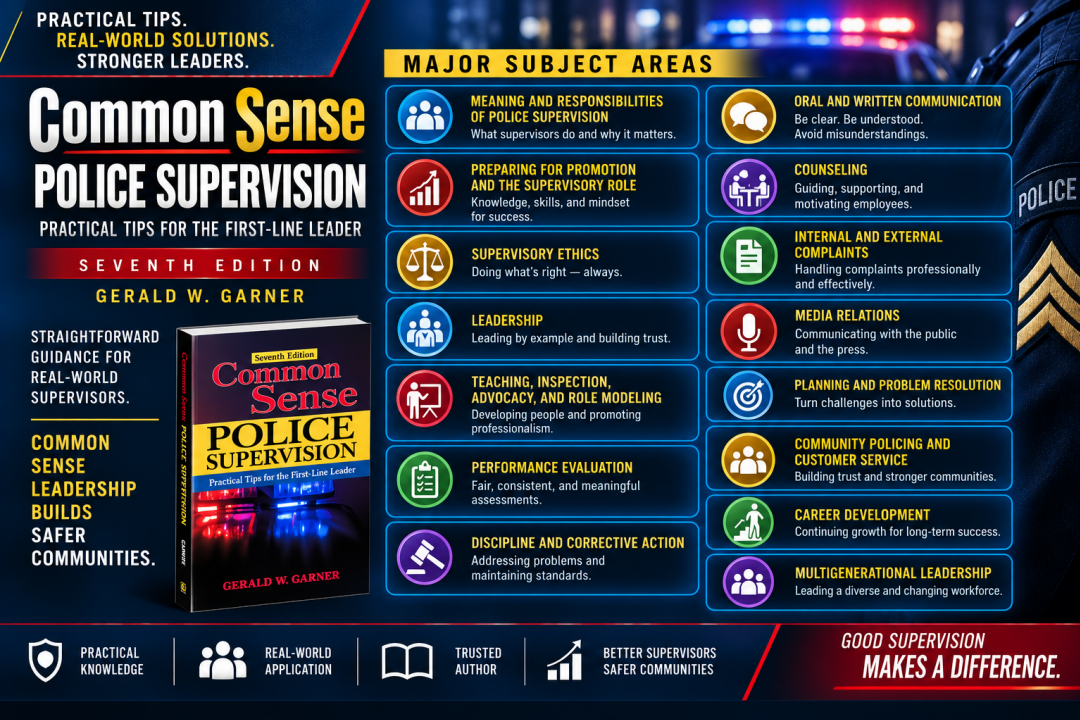
Textbook Overview
Common Sense Police Supervision is one of Chief Gerald Garner's most established contributions to first-line law enforcement leadership. Now in its seventh edition, the book combines practical experience, supervisory judgment, and specific guidance on the responsibilities routinely encountered by Sergeants and other frontline leaders.
The central philosophy is contained in the title. Effective supervision requires policies, training, professional knowledge, and organizational authority—but it also requires judgment, prudence, perspective, and the ability to apply those resources intelligently to real people and real problems.
The seventh edition addresses:
-
training
-
counseling
-
inspection
-
discipline
-
performance assessment
-
planning
-
problem resolution
-
communication
-
media relations
-
complaints
-
community policing
-
customer service
-
career development
-
and leading employees from different generations.
Unlike a theoretical leadership text, Common Sense Police Supervision consistently brings the reader back to the practical question:
What should a good first-line leader actually do? That characteristic helps explain its longevity.
Preparation for Oral Boards and Assessment Centers is part of the draw of this textbook. Understanding and citing the specific leadership principles that define why a supervisory action is taking place, or should take place, is the essence of the oral board, in-basket assessment, role-play exercise and many other modern assessment exercises. Quoting directly from the text shows the ultimate in professional preparation for your new role as a supervisor and leader.
Apply these supervisory principles to future written exams
AND assessment center exercises:
Amazon Link +
Promotion exam questions.
15 Major Subject Areas
- Meaning and responsibilities of police supervision
- Preparing for promotion and the supervisory role
- Supervisory ethics
- Leadership
- Teaching, inspection, advocacy, and role modeling
- Performance evaluation
- Discipline and corrective action
- Oral and written communication
- Counseling
- Internal and external complaints
- Media relations
- Planning and problem resolution
- Community policing and customer service
- Career development
- Multigenerational leadership
The publisher's table of contents even includes preparation for promotional testing, boards, and assessment centers as part of preparing for the supervisory role.
Why This Book Matters
The book matters because police supervision rarely occurs under ideal circumstances.
Why we love this textbook and write promotional exams from it: Supervisors deal with incomplete information, difficult employees, competing demands, emotional situations, organizational pressure, citizen concerns, and decisions that cannot always wait for lengthy analysis. Garner's approach emphasizes sound judgment applied to those realities.
The text is therefore useful not merely as a source of promotional-examination information but as a bridge between knowing supervisory principles and applying them.
That makes the book potentially valuable for written examinations, but also equally valuable for In-Baskets, Role Plays, Situational Judgment Tests, and other exercises requiring candidates to demonstrate how they would actually respond to supervisory problems.
Historical Promotional Influence
The book's continued progression through seven editions provides additional evidence of its durability as a police supervision resource. The fourth edition appeared in 2008, a sixth edition in 2018, and the current seventh edition in 2024.
Even more significantly, Charles C Thomas now publishes a seventh-edition companion study guide explicitly designed to reinforce the book's content and assist promotional students preparing for examinations based upon it.
Current Professional Relevance
The seventh edition's 2024 publication makes this a genuinely current supervision text rather than simply an older classic remaining in circulation.
The current edition specifically recognizes a changing workforce and increasingly complex society while retaining practical instruction in discipline, counseling, communication, complaints, performance evaluation, community policing, and leadership. It also addresses leading different generations within the workforce.
That combination is important.
The enduring responsibilities of Sergeants have not disappeared; they have become more complicated. Employees still require leadership, evaluation, counseling, correction, communication, and development. What has changed is the organizational and social environment in which supervisors perform those duties.
This seventh edition attempts to preserve the practical strengths of the earlier editions while adapting them to that environment.
If This is the Only Leadership Book You Read ...
If Common Sense Police Supervision is the only supervision book you read, you should emerge with a strong practical understanding of the everyday responsibilities of a first-line law enforcement leader.
You will encounter leadership not as an abstract concept but through activities supervisors actually perform: communicating, counseling, evaluating, disciplining, resolving problems, handling complaints, working with the community, developing employees, and preparing themselves for greater responsibility.
The book will not replace agency policy, legal training, or a comprehensive management education. Nor should "common sense" be interpreted as a substitute for professional knowledge.
Its central contribution is different: professional knowledge becomes most useful when a supervisor has the judgment to apply it effectively.
For officers preparing to become Sergeants—and particularly for candidates who want preparation that extends beyond memorizing information for a written examination—that remains a compelling proposition.
Promotion Exam Questions Available for Common Sense Police Supervision: Practical Tips for the First-Line Leader
Click here for exam questions from these editions of the textbook, including a proven study method and bonus items.- Common Sense Police Supervision 7E - 360+ questions
- Common Sense Police Supervision 6E - 330+ questions
- Common Sense Police Supervision 5E - 250+ questions
- Common Sense Police Supervision 4E - 140+ questions
You can also sign up to try our system - no name or credit card needed!
Do You REALLY Want the Promotion? — Textbooks to help you prepare for:
 Police Corporal
Police Detective
Police Sergeant
Police Lieutenant
Police Captain
Police
Administration and Upper Management
Understanding Police Leadership Concepts
Understanding Police Ethical Considerations
Understanding Police
Patrol and Field Operations
Understanding Community
and Problem-Oriented Policing
Understanding Intelligence-Led Policing
Police Case Law
Application with Case Law Pro
Police Corporal
Police Detective
Police Sergeant
Police Lieutenant
Police Captain
Police
Administration and Upper Management
Understanding Police Leadership Concepts
Understanding Police Ethical Considerations
Understanding Police
Patrol and Field Operations
Understanding Community
and Problem-Oriented Policing
Understanding Intelligence-Led Policing
Police Case Law
Application with Case Law ProMaster list of articles and resources: from PolicePromotion.net
Your Police Promotion Timeline — When Should
Preparation Begin?
Field Training — Your First Defining Chapter
Building Your Promotional Reputation Over Time
How Citizen Complaints Can Affect Your Promotion Chances
Recordkeeping —
Your Evaluations, and Training Documentation
Great Police Leaders Focus on the Details — Here's How!
The Two Tracks —
Supervision vs. Specialization
The Role of College Education
in Law Enforcement
The FTO As an Early Promotion Credential
The Written Promotional
Exam — What It Covers and How to Prepare
The Oral Board — the
Promotion First-Timer's Biggest Challenge
The In-Basket Exercise
— NOT as
Easy as You Think!
Assessment Center Exercises
—
Don't Fear — Prepare!
Making it To The Top — Or — How High is
High Enough?
When it's Time to Leave it All Behind — And What to
do Next.