
Supervising Police Personnel: Strengths-Based Leadership
Master This Core Supervision and First-Line Leadership Textbook to Build Toward Your Promotion!

By Lt. Paul Patti (ret) - Director
Police
Career and Promotion Services, LLC.
 What you need to know
about the textbooks you need to study can be found in these pages
- including real promotion test questions from each
title!
What you need to know
about the textbooks you need to study can be found in these pages
- including real promotion test questions from each
title!
Supervising Police Personnel: Strengths-Based Leadership is a core textbook, creating a solid foundation for your future testing and promotion. The 50+ new and classic police promotion textbooks featured on these pages form the professional basis for not only written exams, but also oral board interview questions and assessment center exercises.
Are you interested in moving up the ranks in law enforcement, maybe all the way to Chief or Sheriff? If you are, start today learning concepts and practical information that will be useful in all your written exams, oral boards and assessment center exercises. Amazon Link.
About us: I spent 27 years in law enforcement, and since 1985 I have directed an organization that has worked with individuals and agencies in finding and promoting the right people into the higher ranks of police and sheriff's departments. We include a Ph.D. in Personnel Management, as well as a staff attorney focusing on criminal law applications in law enforcement.
We specialize not only in writing promotion textbook exams for police agencies, but also written exam preparation for individuals, along with in-basket, oral board and assessment center preparation for both agencies and individual training. Our individual client base has a 99%+ pass rate on their written exams!
More information about me, my organization and affiliates can be found at these links; PoliceCareer.com, About Us, PoliceCareer.net, PolicePromotion.com, Finests.com, In-Basket.net and PoliceAssessmentCenter.com.
Questions? Contact me -
Paul@PolicePromotion.com
Supervising Police Personnel: Strengths-Based Leadership is a Core Supervision and First-Line Leadership textbook used to create promotion exams. Click the links for the full evaluation and topic areas for each textbook in this grouping:
Supervision of Police Personnel
Effective Police Supervision
Supervising Police Personnel:
Strengths-Based Leadership
Management and Supervision in Law
Enforcement
Management and Supervision of Law
Enforcement Personnel
Basic Handbook of Police Supervision
Common Sense Police Supervision
Making Sergeant: The Biggest Leap in Law
Enforcement
Police Supervision and Management: In an Era
of Community Policing
On This Page — Supervising
Police Personnel: Strengths-Based Leadership
Authors:
Paul M. Whisenand
Publisher: Pearson —
Current Edition: 8th
By Lt. Paul Patti (ret.), Director,
Police Career and Promotion Services, LLC — 40+ years of law
enforcement promotion expertise.
Textbook Overview
Supervising Police Personnel: Strengths-Based Leadership takes a notably different approach to police supervision. Rather than organizing the subject primarily around administrative tasks, Paul Whisenand structures supervision around the personal and leadership strengths that enable supervisors to perform those tasks successfully.
The eighth edition dates back to 2015, and was one of the first supervision promotion textbooks to organize its material around:
-
character
-
clarity
-
engagement
-
well-being
-
self-control
-
teamwork.
Within that framework are discussions of:
-
decisions
-
values
-
integrity
-
vision
-
communication
-
empowerment
-
performance
-
time
-
happiness
-
stress
-
willpower
-
team leadership
-
community- and problem-oriented policing
-
and results.
This gives the book a distinctly strong leader-development orientation. We still find it relevant today and agencies are still choosing it as a promotion textbook for sergeant exams.
The supervisor is not presented simply as the person responsible for ensuring that work gets done. The text asks what qualities and behaviors allow that individual to lead people successfully while producing organizational results.
That makes the book especially interesting for promotional development because it connects personal leadership qualities with practical supervisory performance.
Preparation for Oral Boards and Assessment Centers is part of the draw of this textbook. Understanding and citing the specific leadership principles that define why a supervisory action is taking place, or should take place, is the essence of the oral board, in-basket assessment, role-play exercise and many other modern assessment exercises. Quoting directly from the text shows the ultimate in professional preparation for your new role as a supervisor and leader.
Apply these supervisory principles to future written exams
AND assessment center exercises:
Amazon Link +
Promotion exam questions.
Major Subject Areas
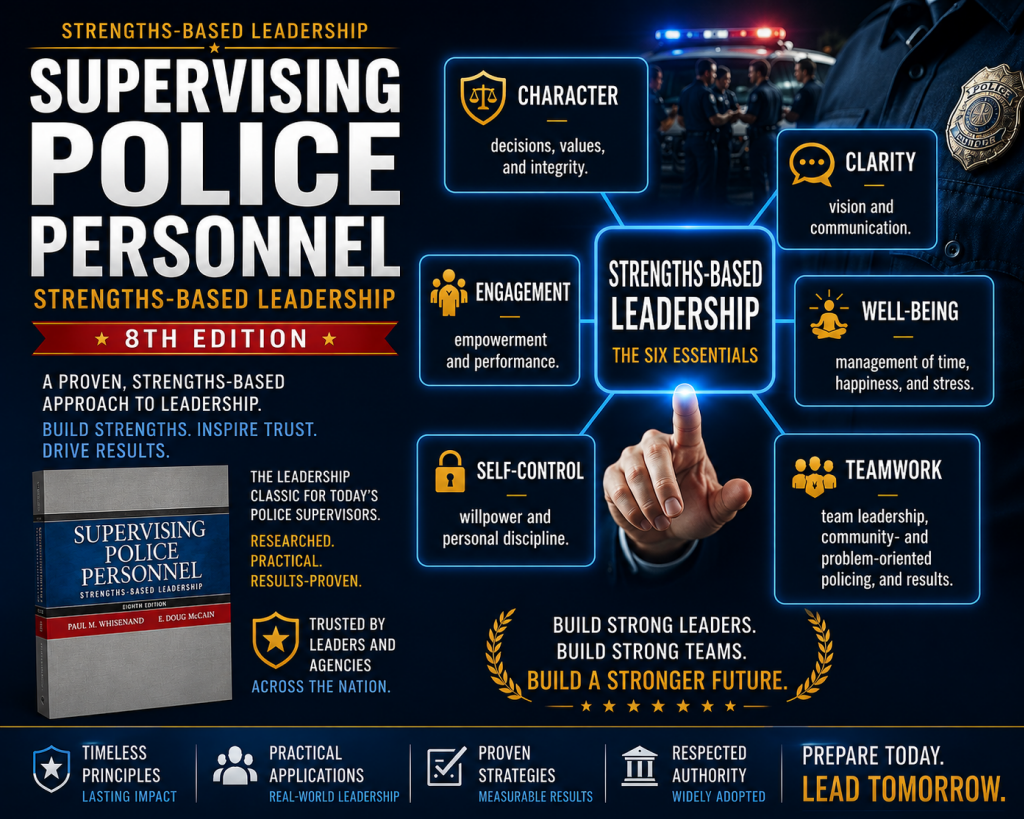
The six-strength framework provides a useful summary of the book's philosophy:
Character — decisions, values, and integrity.
Clarity — vision and communication.
Engagement — empowerment and performance.
Well-Being — management of time, happiness, and stress.
Self-Control — willpower and personal discipline.
Teamwork — team leadership, community- and problem-oriented policing, and results.
Additional recurring concerns this textbook addresses include ethics, employee development, evaluation, organizational behavior, communication, and the relationship between human factors and performance.
Pearson describes the book as combining the "human factor" with a performance orientation.
That balance is the heart of the book. Effective supervision requires both people-centered leadership and measurable organizational performance.
Why This Book Matters
This book matters because it challenges the assumption that supervision can be reduced to a collection of administrative techniques.
Two supervisors can know
the same policies and procedures yet produce dramatically
different results. Why?
 Character
Communication
Judgment
Self-control
Ability
to motivate
Ability
to build teams
Ability
to handle stress.
Those are precisely the kinds of
variables Whisenand's strengths-based framework brings to the
foreground.
Why we love this textbook and write promotional exams from it: For promotional candidates, that makes the book particularly valuable in developing the broader leadership qualities that written examinations sometimes struggle to measure directly but assessment centers routinely attempt to observe.
A candidate facing a difficult Role Play, LGD, In-Basket, or SJT is demonstrating many of the same competencies emphasized throughout this book.
Historical Promotional Influence
The history of the work extends considerably further back than the current strengths-based title might initially suggest.
Earlier editions of Whisenand's Supervising Police Personnel were organized around "the fifteen responsibilities"; library records document a second edition from the early 1990s, while the present work has progressed to an eighth edition.
That multi-edition history establishes the work as a longstanding police-supervision text rather than a recent leadership publication.
The eighth edition represents a significant conceptual evolution: the material is reorganized around leadership strengths while retaining practical supervisory responsibilities. Pearson specifically identifies the edition as intended for courses in police supervision.
Its historical significance lies partly in its ability to evolve from traditional supervisory responsibilities toward a more contemporary leadership-development model.
Current Professional Relevance
The eighth edition dates from 2014/2015, making it more than a decade old.
Certain examples, technologies, research references, and contemporary policing discussions should therefore be supplemented with newer resources.
However, the book's central framework has aged considerably better than its publication date might suggest.
Character, integrity, communication, empowerment, employee performance, stress management, self-control, teamwork, and problem solving remain highly relevant supervisory competencies. Indeed, current concerns about officer wellness, workforce retention, organizational culture, ethical leadership, and employee engagement make several of these themes arguably more important today.
We in Police Career and Promotion Services, LLC classify this promotional exam title as:
An established earlier-generation text whose central leadership concepts retain strong contemporary relevance.
If This is the Only Leadership Book You Read ...
If Supervising Police Personnel: Strengths-Based Leadership is the only supervision book you read, its most important contribution may be changing the way you think about what makes a supervisor effective.
You will learn that supervisory success is not determined simply by rank, authority, policy knowledge, or technical expertise.
Effective supervisors require character. They communicate a clear direction. They engage and empower employees. They manage their own stress and behavior. They develop teams. And ultimately, they must produce results.
Because the current edition is more than a decade old, it should be supplemented for rapidly changing legal, technological, and policy issues.
But its fundamental lesson remains sound:
Before supervisors can successfully lead other people, they must develop the personal strengths necessary to lead themselves.
Promotion Exam Questions Available for Supervising Police Personnel: Strengths-Based Leadership
Click here for exam questions from these editions of the textbook, including a proven study method and bonus items. You can also sign up to try our system - no name or credit card needed:Supervising Police Personnel - Strengths Based Leadership 8th Edition - 250+ questions
Supervising Police Personnel - The Fifteen Responsibilities 7th Edition - 190+ questions
Do You REALLY Want the Promotion? — Textbooks to help you prepare for:
Police Corporal
Police Detective
Police Sergeant
Police Lieutenant
Police Captain
Police
Administration and Upper Management
Understanding Police Leadership Concepts
Understanding Police Ethical Considerations
Understanding Police
Patrol and Field Operations
Understanding Community
and Problem-Oriented Policing
Understanding Intelligence-Led Policing
Police Case Law
Application with Case Law ProMaster list of articles and resources: from PolicePromotion.net
Your Police Promotion Timeline — When Should
Preparation Begin?
Field Training — Your First Defining Chapter
Building Your Promotional Reputation Over Time
How Citizen Complaints Can Affect Your Promotion Chances
Recordkeeping —
Your Evaluations, and Training Documentation
Great Police Leaders Focus on the Details — Here's How!
The Two Tracks —
Supervision vs. Specialization
The Role of College Education
in Law Enforcement
The FTO As an Early Promotion Credential
The Written Promotional
Exam — What It Covers and How to Prepare
The Oral Board — the
Promotion First-Timer's Biggest Challenge
The In-Basket Exercise
— NOT as
Easy as You Think!
Assessment Center Exercises
—
Don't Fear — Prepare!
Making it To The Top — Or — How High is
High Enough?
When it's Time to Leave it All Behind — And What to
do Next.