
Effective Police Supervision
Master This Core Supervision and First-Line Leadership Textbook to Build Toward Your Promotion!

By Lt. Paul Patti (ret) - Director
Police
Career and Promotion Services, LLC.
 What you need to know
about the textbooks you need to study can be found in these pages
- including real promotion test questions from each
title!
What you need to know
about the textbooks you need to study can be found in these pages
- including real promotion test questions from each
title!
Effective Police Supervision is a core textbook, creating a solid foundation for your future testing and promotion. The 50+ new and classic police promotion textbooks featured on these pages form the professional basis for not only written exams, but also oral board interview questions and assessment center exercises.
Are you interested in moving up the ranks in law enforcement, maybe all the way to Chief or Sheriff? If you are, start today learning concepts and practical information that will be useful in all your written exams, oral boards and assessment center exercises. Amazon Link.
About us: I spent 27 years in law enforcement, and since 1985 I have directed an organization that has worked with individuals and agencies in finding and promoting the right people into the higher ranks of police and sheriff's departments. We include a Ph.D. in Personnel Management, as well as a staff attorney focusing on criminal law applications in law enforcement.
We specialize not only in writing promotion textbook exams for police agencies, but also written exam preparation for individuals, along with in-basket, oral board and assessment center preparation for both agencies and individual training. Our individual client base has a 99%+ pass rate on their written exams!
More information about me, my organization and affiliates can be found at these links; PoliceCareer.com, About Us, PoliceCareer.net, PolicePromotion.com, Finests.com, In-Basket.net and PoliceAssessmentCenter.com.
Questions? Contact me -
Paul@PolicePromotion.com
Effective Police Supervision is a Core Supervision and First-Line Leadership textbook used to create promotion exams. Click the links for the full evaluation and topic areas for each textbook in this grouping:
Supervision of Police Personnel
Effective Police Supervision
Supervising Police Personnel:
Strengths-Based Leadership
Management and Supervision in Law
Enforcement
Management and Supervision of Law
Enforcement Personnel
Basic Handbook of Police Supervision
Common Sense Police Supervision
Making Sergeant: The Biggest Leap in Law
Enforcement
Police Supervision and Management: In an Era
of Community Policing
On This Page — Effective
Police Supervision
Authors:
Larry S. Miller, Harry W. More, Michael C. Braswell
Publisher: Routledge —
Current Edition: 9th
By Lt. Paul Patti (ret.), Director,
Police Career and Promotion Services, LLC — 40+ years of law
enforcement promotion expertise.
Textbook Overview
For more than three decades,
Effective Police Supervision has been
one of the most recognized and widely adopted textbooks on
first-line police supervision in the United States. Through
multiple editions, it has remained a dependable resource for
college criminal justice programs, supervisory development
courses, and law enforcement agencies developing promotional
reading lists for Sergeant examinations.
Its continued publication reflects both the enduring importance of effective supervision and the authors' efforts to keep the content aligned with contemporary policing issues.
Preparation for Oral Boards and Assessment Centers is part of the draw of this textbook. Understanding and citing the specific leadership principles that define why a supervisory action is taking place, or should take place, is the essence of the oral board, in-basket assessment, role-play exercise and many other modern assessment exercises. Quoting directly from the text shows the ultimate in professional preparation for your new role as a supervisor and leader.
Apply these supervisory principles to future written exams AND assessment center exercises: Amazon Link + Promotion exam questions.
Unlike textbooks that focus primarily on police administration or executive leadership, Effective Police Supervision concentrates on the day-to-day responsibilities of the first-line supervisor. The book examines the practical challenges faced by Sergeants and other frontline leaders, including leading personnel, communicating effectively, motivating employees, evaluating performance, handling discipline, managing organizational change, and responding to critical incidents.
Throughout the text, the emphasis remains on translating
management and leadership principles into practical supervisory
responsibilities.
One
of the textbook's greatest strengths is its
ability to combine established supervisory principles with
current developments affecting modern policing. The Ninth
Edition incorporates updated legal considerations, contemporary
research, police accountability, recruitment and retention
challenges, social media, community expectations, COVID-19
operational issues, and managing protests, while preserving the
core supervisory concepts that have made the book a longstanding
promotional examination resource.
From our perspective as
exam writers, the book has consistently demonstrated exceptional
value as both a professional development resource and a
promotional examination text. Its broad coverage of supervision,
leadership, organizational behavior, and personnel management
provides agencies with a well-rounded foundation for written
promotional examinations while encouraging officers to think
beyond memorization and toward becoming effective supervisors.
Based on our experience developing promotional examinations
for municipal police departments and sheriff's offices, it
remains one of the foundational supervision texts that agencies
continue to select for Corporal, Detective and Sergeant
promotional processes.
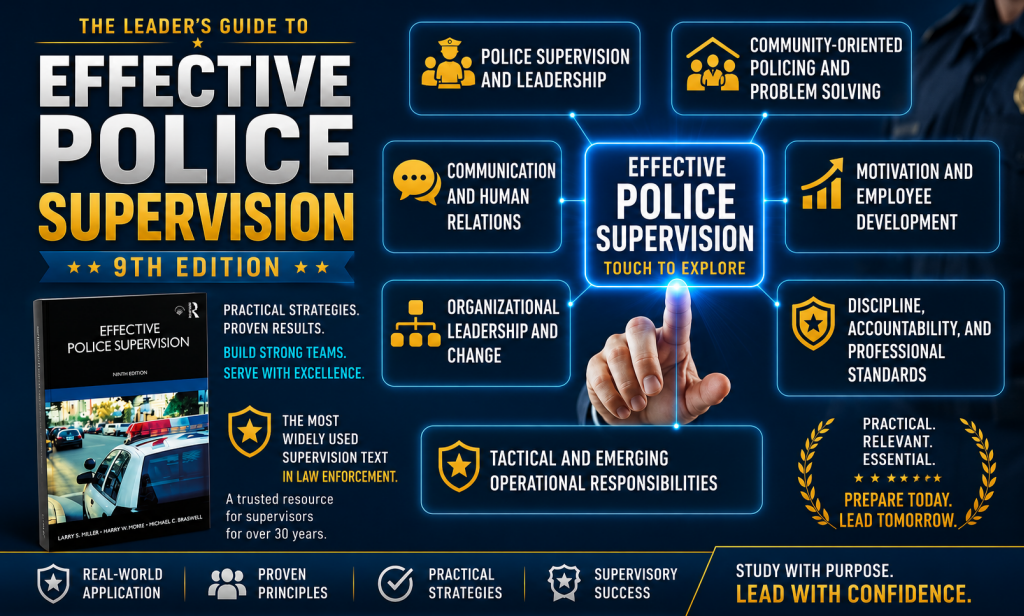
Major Subject Areas
Rather than presenting supervision as a collection of
isolated management techniques, Effective Police Supervision
approaches police leadership as an integrated responsibility
requiring sound judgment, communication, organizational
awareness, and professional accountability. The major subject
areas throughout the book include:
Police Supervision and
Leadership
The transition from police
officer to supervisor forms the foundation of the textbook.
Leadership is presented as an ongoing responsibility involving
influence, accountability, decision-making, and professional
example rather than simply exercising rank or authority.
Community-Oriented Policing
and Problem Solving
The book examines the
supervisor's role in supporting community partnerships,
problem-solving initiatives, and neighborhood quality of life,
recognizing that modern supervision extends beyond internal
personnel management.
Communication and Human Relations
Effective communication is emphasized as one of the supervisor's
most important tools. Topics include interpersonal
communication, conflict resolution, coaching, counseling, and
maintaining productive relationships within the organization.
Motivation and Employee
Development
The authors discuss methods
for motivating employees, conducting performance evaluations,
mentoring officers, and developing personnel throughout their
careers. These responsibilities are presented as essential
components of effective supervision rather than secondary
administrative duties.
Organizational Leadership and Change
Recognizing that policing continually evolves, the textbook
addresses leadership during organizational change, team
development, labor relations, diversity, accountability, and
adapting to changing operational demands.
Discipline, Accountability,
and Professional Standards
The book
devotes significant attention to supervisory responsibility for
discipline, internal accountability, ethical conduct, and
maintaining organizational standards. These subjects reflect the
central role first-line supervisors play in preserving
professionalism and public confidence.
Tactical and Emerging
Operational Responsibilities
The Ninth
Edition also addresses tactical operations, homeland security,
terrorism, recruitment and retention, and other contemporary
issues affecting police supervision. These additions help keep
the book relevant for today's law enforcement environment.
Why This Book Matters
Few career transitions in law enforcement are as challenging
as the move from officer to Sergeant. Success in that role
depends not only on technical knowledge and experience but also
on the ability to lead people, solve problems, communicate
effectively, and make sound decisions under pressure.
Effective Police Supervision
was written specifically to prepare supervisors for those
responsibilities.
The textbook matters because it
addresses supervision as both a
management function and a leadership responsibility.
Rather than limiting its discussion to policies and procedures,
it explores the human side of supervision:
- motivating employees
- resolving conflict
- building teams
- mentoring officers
- evaluating performance
- and promoting ethical conduct
- accountability
- labor relations
- legal issues
- community expectations
- and operational leadership.
For agencies, the book provides a comprehensive and balanced
foundation for promotional reading lists. For candidates, it
offers one of the broadest introductions available to the
responsibilities of first-line supervision. Its continuing
revisions demonstrate an ongoing effort to reflect changes in
policing while maintaining the core supervisory principles that
have made it a respected resource for decades.
Historical Promotional Influence
Over many years of promotional examination development,
Effective Police Supervision has established itself as one of
the defining supervision texts used for Sergeant promotional
examinations. While no comprehensive national database tracks
textbook adoption by police agencies, the book has remained in
continuous publication through multiple editions and continues
to be marketed specifically for police supervision, promotional
examination preparation, and professional development.
In
our experience working with municipal police departments and
county sheriff's offices, this title has consistently appeared among
the most frequently selected supervision textbooks for Sergeant
promotional processes. Its longevity is attributable to three
factors:
 Comprehensive coverage of supervisory responsibilities.
A
practical balance between leadership theory and day-to-day
police supervision.
Regular updates that address changes in the policing profession
while preserving established supervisory principles.
Why we love this textbook and write promotional exams
from it:
Unlike narrowly focused management books, Effective Police
Supervision has maintained broad appeal because it serves
multiple purposes simultaneously—as an academic text, a
supervisory training resource, and a promotional examination
reference. That versatility has contributed significantly to its
long-standing influence within law enforcement education.
Current Professional Relevance
Although the fundamental responsibilities of first-line
supervision have changed little over time, the environment in
which police supervisors operate continues to evolve. Today's
supervisors must address increased public scrutiny,
technological change, recruitment and retention challenges,
officer wellness, social media, legal developments, and
heightened expectations for organizational accountability.
The Ninth Edition reflects many of these contemporary issues
through updated discussions of police accountability,
recruitment and retention, current legal developments, social
media, COVID-19 operational challenges, and managing public
demonstrations. These additions complement the book's
longstanding coverage of leadership, communication, personnel
management, ethics, and organizational behavior.
From our
perspective, the textbook remains highly relevant because it
continues to teach principles that transcend specific policies
or procedures. Leadership, communication, employee development,
ethical decision-making, and organizational accountability
remain essential responsibilities for first-line supervisors
regardless of agency size or jurisdiction. While agencies may
supplement the text with local policies and state-specific legal
materials, the supervisory principles presented throughout the
book remain broadly applicable to modern law enforcement.
If This is the Only Leadership Book You Read ...
If Effective Police
Supervision is the only supervision textbook you
study before competing for promotion to Sergeant, you will gain
a comprehensive introduction to the responsibilities and
expectations of first-line police leadership. More importantly,
you will begin to understand that effective supervision extends
far beyond enforcing policies and assigning work.
The
book emphasizes that successful supervisors lead people,
communicate effectively, develop employees, promote ethical
conduct, solve organizational problems, and contribute directly
to the effectiveness of their agencies. It encourages officers
to think beyond the technical aspects of policing and to
appreciate the broader leadership responsibilities that
accompany promotion.
No single textbook can prepare an
officer for every promotional examination or every supervisory
challenge. However, Effective Police Supervision provides one of
the strongest foundational introductions available to police
supervision and continues to merit serious consideration by
agencies developing promotional reading lists and by officers
committed to long-term professional development.
Promotion Exam Questions Available for Effective Police Supervision
Click here for exam questions from these editions of the textbook, including a proven study method and bonus items. You can also sign up to try our system - no name or credit card needed:Effective Police Supervision - More and Miller 9th Edition - 550+ questions
Effective Police Supervision - More and Miller 8th Edition - 500+ questions
Effective Police Supervision - More and Miller 7th Edition - 390+ questions
Effective Police Supervision - More and Miller 6th Edition - 270+ questions
Effective Police Supervision - More and Miller 5th Edition - 280 questions
Do You REALLY Want the Promotion? — Textbooks to help you prepare for:
 Police Corporal
Police Detective
Police Sergeant
Police Lieutenant
Police Captain
Police
Administration and Upper Management
Understanding Police Leadership Concepts
Understanding Police Ethical Considerations
Understanding Police
Patrol and Field Operations
Understanding Community
and Problem-Oriented Policing
Understanding Intelligence-Led Policing
Police Case Law
Application with Case Law Pro
Police Corporal
Police Detective
Police Sergeant
Police Lieutenant
Police Captain
Police
Administration and Upper Management
Understanding Police Leadership Concepts
Understanding Police Ethical Considerations
Understanding Police
Patrol and Field Operations
Understanding Community
and Problem-Oriented Policing
Understanding Intelligence-Led Policing
Police Case Law
Application with Case Law ProMaster list of articles and resources: from PolicePromotion.net
Your Police Promotion Timeline — When Should
Preparation Begin?
Field Training — Your First Defining Chapter
Building Your Promotional Reputation Over Time
How Citizen Complaints Can Affect Your Promotion Chances
Recordkeeping —
Your Evaluations, and Training Documentation
Great Police Leaders Focus on the Details — Here's How!
The Two Tracks —
Supervision vs. Specialization
The Role of College Education
in Law Enforcement
The FTO As an Early Promotion Credential
The Written Promotional
Exam — What It Covers and How to Prepare
The Oral Board — the
Promotion First-Timer's Biggest Challenge
The In-Basket Exercise
— NOT as
Easy as You Think!
Assessment Center Exercises
—
Don't Fear — Prepare!
Making it To The Top — Or — How High is
High Enough?
When it's Time to Leave it All Behind — And What to
do Next.