Police Supervision and Management: In an Era of Community Policing
Master This Core Supervision and First-Line Leadership Textbook to Build Toward Your Promotion!

By Lt. Paul Patti (ret) - Director
Police
Career and Promotion Services, LLC.
 What you need to know
about the textbooks you need to study can be found in these pages
- including real promotion test questions from each
title!
What you need to know
about the textbooks you need to study can be found in these pages
- including real promotion test questions from each
title!
Police Supervision and Management: In an Era of Community Policing is a core textbook, creating a solid foundation for your future testing and promotion. The 50+ new and classic police promotion textbooks featured on these pages form the professional basis for not only written exams, but also oral board interview questions and assessment center exercises.
Are you interested in moving up the ranks in law enforcement, maybe all the way to Chief or Sheriff? If you are, start today learning concepts and practical information that will be useful in all your written exams, oral boards and assessment center exercises. Amazon Link.
About us: I spent 27 years in law enforcement, and since 1985 I have directed an organization that has worked with individuals and agencies in finding and promoting the right people into the higher ranks of police and sheriff's departments. We include a Ph.D. in Personnel Management, as well as a staff attorney focusing on criminal law applications in law enforcement.
We specialize not only in writing promotion textbook exams for police agencies, but also written exam preparation for individuals, along with in-basket, oral board and assessment center preparation for both agencies and individual training. Our individual client base has a 99%+ pass rate on their written exams!
More information about me, my organization and affiliates can be found at these links; PoliceCareer.com, About Us, PoliceCareer.net, PolicePromotion.com, Finests.com, In-Basket.net and PoliceAssessmentCenter.com.
Questions? Contact me -
Paul@PolicePromotion.com
Police Supervision and Management: In an Era of Community Policing is a Core Supervision and First-Line Leadership textbook used to create promotion exams. Click the links for the full evaluation and topic areas for each textbook in this grouping:
Supervision of Police Personnel
Effective Police Supervision
Supervising Police Personnel:
Strengths-Based Leadership
Management and Supervision in Law
Enforcement
Management and Supervision of Law
Enforcement Personnel
Basic Handbook of Police Supervision
Common Sense Police Supervision
Making Sergeant: The Biggest Leap in Law
Enforcement
Police Supervision and Management: In an Era
of Community Policing
On This Page — Police
Supervision and Management: In an Era of Community Policing
Authors:
Peak, Gaines and Glensor
Publisher: Pearson —
Current Edition: 3rd
By Lt. Paul Patti (ret.), Director,
Police Career and Promotion Services, LLC — 40+ years of law
enforcement promotion expertise.
Textbook Overview
Police Supervision and Management: In an Era of Community Policing is a comprehensive supervision and management text built around the realities of leading police personnel while operating within a community-oriented policing environment.
This third edition draws upon more than 100 years of combined professional and academic experience and as providing an insider’s view of the demanding work of police supervisors and managers. It is also a fantastic study tool for officers preparing for promotional examinations and assessment exercises within a COP-POP agency.
Why we like this textbook and use it for promotion exams: The book’s scope extends well beyond community policing alone. Subjects include
-
leadership and motivation
-
communication and negotiation
-
human resources
-
training
-
performance appraisal
-
stress and wellness
-
ethics and liability
-
discipline
-
deployment
-
patrol operations
-
tactical incidents
-
homeland security
-
community policing and problem solving.
The title phrase “in an era of community policing” establishes the philosophical setting, but the book remains fundamentally a broad police supervision and management textbook.
Preparation for Oral Boards and Assessment Centers is part of the draw of this textbook. Understanding and citing the specific community-oriented focus, along with the leadership principles that define why a supervisory action is taking place, or should take place, is the essence of the oral board, in-basket assessment, role-play exercise and many other modern assessment exercises. Quoting directly from the text shows the ultimate in professional preparation for your new role as a supervisor and leader within a community policing agency.
Apply these supervisory principles to future written exams
AND assessment center exercises:
Amazon Link +
Promotion exam questions.
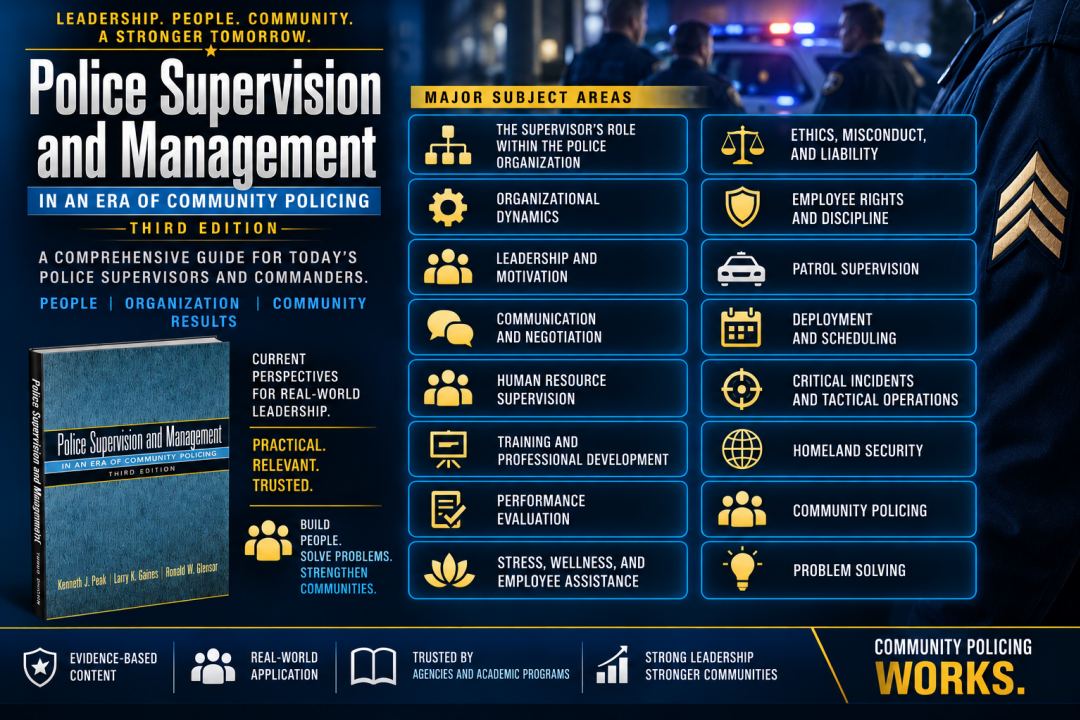
Major Subject Areas
- The supervisor’s role within the police organization
- Organizational dynamics
- Leadership and motivation
- Communication and negotiation
- Human resource supervision
- Training and professional development
- Performance evaluation
- Stress, wellness, and employee assistance
- Ethics, misconduct, and liability
- Employee rights and discipline
- Patrol supervision
- Deployment and scheduling
- Critical incidents and tactical operations
- Homeland security
- Community policing
- Problem solving
These areas demonstrate why the book has historically worked well for both Sergeant and Lieutenant preparation: it moves from direct personnel supervision into operational and organizational management without abandoning the realities of community-oriented and traditional field policing.
Why This Book Matters
This book matters because it treats police supervision as both an internal leadership responsibility and an external community responsibility.
A supervisor must lead employees, evaluate performance, handle discipline, manage resources, and respond to critical incidents. At the same time, the supervisor operates in an environment where community relationships, problem solving, public expectations, and organizational legitimacy influence daily police work.
That combination gives the book unusually broad relevance.
Why we love this textbook and write promotional exams from it: Its treatment of critical incidents, patrol operations, communication, human resources, and community-oriented problem solving also makes it useful beyond conventional multiple-choice testing. Many of these subjects translate naturally into In-Baskets, Role Plays, SJTs, oral problem-analysis exercises, and tactical or administrative scenarios.
Historical Promotional Influence
This title is a valuable study tool for officers preparing for promotional examinations. A 2015 City of Cleburne, Texas Sergeant examination announcement listed the third edition as promotional study material. More strikingly, Fort Bend County, Texas was still recommending the second edition for a Sergeant process in 2022, demonstrating how long older editions of this work remained in departmental promotional libraries.
The book qualifies as a genuine
promotional-era
classic, particularly for Sergeant and Lieutenant
examinations emphasizing community-oriented supervision and
field management.
Current Professional Relevance
The third edition was published in 2010. Consequently, many of its fundamental topics remain useful, but a contemporary agency should not assume that a sixteen-year-old police management textbook fully reflects the current professional environment.
Leadership, communication, motivation, training, evaluation, employee rights, discipline, wellness, deployment, critical-incident management, community policing, and problem solving remain highly relevant supervisory subjects.
What requires supplementation are the developments that have dramatically changed since 2010: body-worn-camera practices, contemporary de-escalation doctrine, social media, modern officer-wellness initiatives, post-2020 accountability reforms, rapidly changing technology, current recruitment and retention problems, and recent legal and community expectations.
If This is the Only Leadership Book You Read ...
If Police Supervision and Management: In an Era of Community Policing is the only supervision book you read, you will gain an unusually broad understanding of the police supervisor’s responsibilities.
You will encounter personnel leadership, motivation, communication, training, discipline, performance evaluation, patrol management, critical incidents, community policing, and problem solving within one framework.
Its greatest lesson may be that police supervision cannot be separated cleanly into “inside the department” and “outside in the community.” Effective supervisors must manage both.
Because the current edition is now somewhat dated, it should not stand alone as a complete guide to contemporary policing. But as a broad foundation in the responsibilities of police supervision and management—and as a historically important promotional textbook —it continues to offer substantial value.
Promotion Exam Questions Available for Police Supervision and Management: in an Era of Community Policing
Click here for exam questions from these editions of the textbook, including a proven study method and bonus items. You can also sign up to try our system - no name or credit card needed:Police Supervision and Management: In An Era of Community Policing Peak 3E - 150+ questions
Do You REALLY Want the Promotion? — Textbooks to help you prepare for:
 Police Corporal
Police Detective
Police Sergeant
Police Lieutenant
Police Captain
Police
Administration and Upper Management
Understanding Police Leadership Concepts
Understanding Police Ethical Considerations
Understanding Police
Patrol and Field Operations
Understanding Community
and Problem-Oriented Policing
Understanding Intelligence-Led Policing
Police Case Law
Application with Case Law Pro
Police Corporal
Police Detective
Police Sergeant
Police Lieutenant
Police Captain
Police
Administration and Upper Management
Understanding Police Leadership Concepts
Understanding Police Ethical Considerations
Understanding Police
Patrol and Field Operations
Understanding Community
and Problem-Oriented Policing
Understanding Intelligence-Led Policing
Police Case Law
Application with Case Law ProMaster list of articles and resources: from PolicePromotion.net
Your Police Promotion Timeline — When Should
Preparation Begin?
Field Training — Your First Defining Chapter
Building Your Promotional Reputation Over Time
How Citizen Complaints Can Affect Your Promotion Chances
Recordkeeping —
Your Evaluations, and Training Documentation
Great Police Leaders Focus on the Details — Here's How!
The Two Tracks —
Supervision vs. Specialization
The Role of College Education
in Law Enforcement
The FTO As an Early Promotion Credential
The Written Promotional
Exam — What It Covers and How to Prepare
The Oral Board — the
Promotion First-Timer's Biggest Challenge
The In-Basket Exercise
— NOT as
Easy as You Think!
Assessment Center Exercises
—
Don't Fear — Prepare!
Making it To The Top — Or — How High is
High Enough?
When it's Time to Leave it All Behind — And What to
do Next.